
Science
Intent
At South Wootton Infant, we believe that every child should be entitled to an inclusive, high quality science education. We aim to provide a broad, balanced and differentiated curriculum where pupils develop the knowledge, skills, vocabulary and a love of science. Our aim is for a science curriculum that engages, inspires and challenges pupils to create their own investigations and ensure that they gain the knowledge and skills to develop their knowledge and learn how science is used in the wider world as well as how famous scientists have influenced the world in which we live today.
Implementation
Science is taught as part of half termly /whole termly topics. Teachers plan collaboratively using the Science progression grid to ensure that the correct objectives are covered across each year group and across the school. This is progressive. Science is taught as a group or whole class session as part of science lessons, forest school lessons or outdoor learning sessions. Staff are encouraged to use correct science vocabulary and concepts, ensuring that planning refers to key vocabulary to be taught in each year group. Staff approach the beginning of science lessons in a variety of different ways such as starting with a story, scientist, topic related question or scenario. It is important that barriers to English and Maths do not affect science learning so work /thoughts can be scribed or photographic evidence used instead. Science is taught as stand- alone science lessons and as part of STEM lessons. Work is recorded in books, on tapestry as photographic evidence, as whole class results (such as a graph or table) or in discussions. In Year2, children are encouraged to explore equipment themselves and investigate using their own ideas based on prior knowledge. Outside visitors and educational trips are used to enhance knowledge and understanding of science.
Impact
The skills and attributes developed through our science curriculum ensures that our children will each make progress relative to their own individual starting point. There will be a clear progression of skills through the year groups and these will be reflected in the planned lessons and the recorded outcomes. Progression of skills, vocabulary and knowledge taught and gained.
How equality, diversity and citizenship is embedded in Science teaching and learning.
The children all participate in Science lessons and skills taught are differentiated according to the different levels and needs.. The children develop a sense of belonging and self-esteem though team work and they develop qualities of self-discipline, commitment and perseverance in their lessons through investigations and knowledge lessons. The children are all taught to care for the science resources and they develop a sense of community when taking part in in school activities throughout the year.
If you were to walk into a science lesson at SWIS you would see;
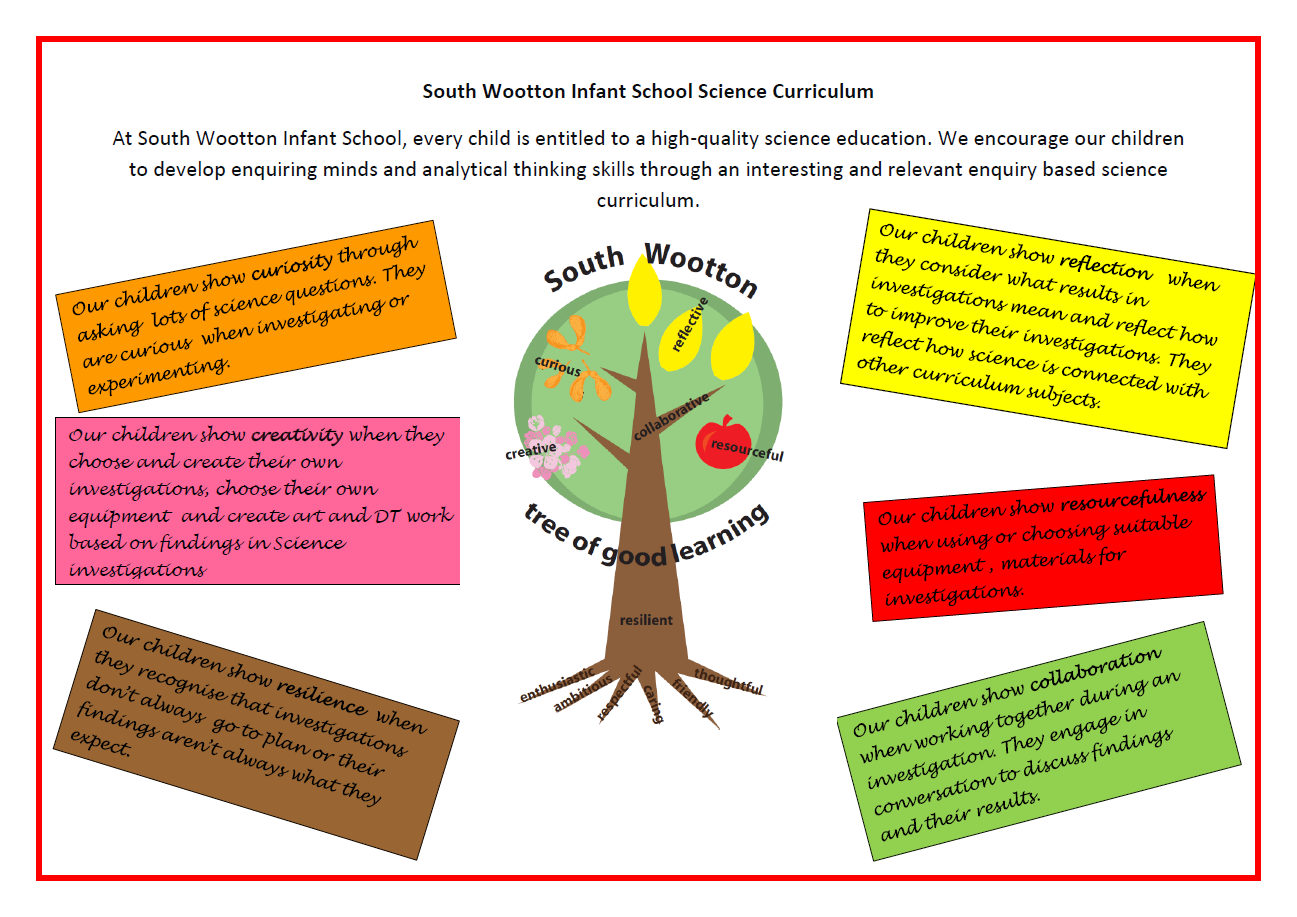
- Children who are curious about investigations, materials, plants, animals, seasons and the lives of scientists.
- Children who show resilience and resourcefulness when investigating and looking for evidence when trying to find answers to their questions.
- Children who are reflective when talking about the outcomes of investigations.
Pupil Voice
Year 2 'I liked it when we learnt about how animals camouflage.'
Year 2 'I liked it when we learnt how exercise makes us feel. When we did exercise I felt hot and sweaty.'
Year 2 'I liked learning about food chains. I know that predators are at the top of the food chain. They hunt other animals they want to eat. I know that a plant is at the start of a food chain.'
Year 1 'I learnt that there are 4 seasons, Autumn, Winter, Spring and Summer. I know that leaves fall in Autumn and animals hibernate. Birds migrate to hot countries.'
Year 1 'I learnt about animals. I know a mammal gives birth to babies and they don’t lay eggs. They have fur or skin. Some have skin, we have skin and we are mammals.'
Year 1 'We built the Three Little Pigs House from sticks, this was strong. We know that castles were made from wood but they weren’t as strong as stone. Wood could catch fire.'