
Religious Education
Intent
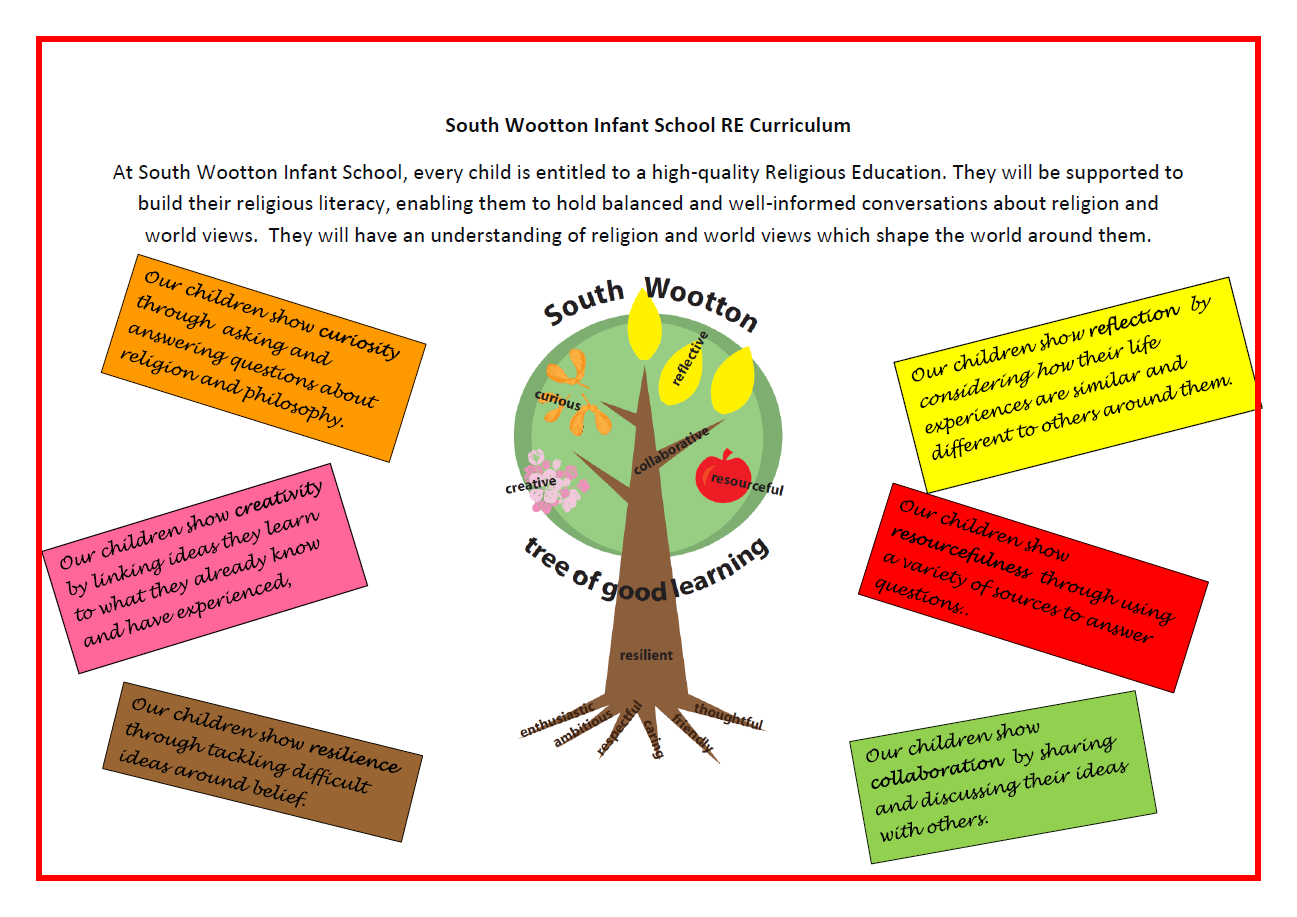
At South Wootton Infant School, we believe that every child is entitled to a high-quality Religious Education and it is our intent to provide this. Our pupils will experience RE as a multi-disciplinary subject. We will provide opportunities for the children to experience the disciplinary fields of theology, philosophy and the human/social sciences. We will ensure that the children have an in-depth investigation of Christianity from Reception and continuing through Year One and Year Two. The other principal world religions which will be studied are Hinduism in Year One and Islam in Year Two. We will ensure they also encounter world views. They will be supported to build their religious literacy, enabling them to hold balanced and well-informed conversations about religion and world views. They will have an understanding of religion and world views which shape the world around them.
Implementation
- RE is taught as four to five one off hour long lessons over a half term or as an RE day once every half term. It is planned using the RE progression grid and the Norfolk Agreed Syllabus for RE in order to ensure coverage.
- Theology will be taught as thinking through believing, Philosophy as thinking through thinking and Human and Social Sciences as thinking through living.
- RE lessons are delivered to the children as a whole class and sometimes as a whole year group.
- Knowledge, awareness and understanding are developed further either in whole class or smaller groups or through independent activities and tasks.
- All year groups use Tapestry to share learning experiences with the parents where appropriate.
- Where work is recorded it is done so in individual RE folders or on display in the classroom or year group corridors.
Impact
- The knowledge, awareness and understanding that the children gain will be evident in the work in their RE folders and on RE based displays. Their pupil voice can be expressed in their work, in displays and in the lessons where they are encouraged to ask questions and discuss what they have learnt further.
- There will be an opportunity for the children to have a range of first-hand experiences in school and in religious settings through the year groups and these will be reflected in the planned lessons and the recorded outcomes.
- Pupils understanding and experiences of RE should be memorable and something that when asked about they are able to recall in some detail.
If you were to walk into an RE lesson at SWIS you would see:
- Children showing curiosity through asking and answering questions about religion and philosophy.
- Children who show creativity by linking ideas they learn to what they already know and have experienced and them being reflective when considering how their life experiences are similar and different to others around them.
- The children working collaboratively and showing resourcefulness when using a variety of sources to answer questions and by sharing and discussing their ideas with others.
How equality, diversity and citizenship is embedded in RE teaching and learning
Through RE in our school children learn about how religion is a part of many people’s lives and how events are remembered and celebrated in different ways but with the same values and reasons at the core of them. Children will learn to respect others ideas and opinions and celebrate the joy in the differences between us all as individuals as well as people of different faiths. Children will be able to see how stories from different religions have a moral lesson and are often told and shared to help people to learn about life and to be the best they can be for themselves and others. We provide children with the opportunity to discuss moral issues and choices that people have made. We encourage children to examine their own choices and to learn what is right and wrong for them and those around them. Children will be able to reflect on how as a British citizen we live alongside other British citizens and visitors to our country many of whom are from different faiths. They will begin to experience how their lives are similar to or different to their own and be given the tools to see that we are equals no matter what our gender, faith or belief’s. They will be able to start to appreciate how lives can be enriched by belonging to a faith.
Pupil Voice
“We went to the church to see the special windows.” (Year One child)
“Christians go to church. When the babies come there with water they put a cross on their head with special water.” (Year One child)
The children are able to recall stories they have heard about different religions and they have experienced the ways in which people from different religions remember and celebrate these. These experiences are what are most memorable to them…..candles, food, dances, artefacts and so on.